


News
Search All News
Tuesday, November 10, 2026
Office Hours
Monday - Friday 9am - 5pmClosed Sat. and Sun.


New NIH Grants are SuRE to Advance Student Research in Chemistry, Biology
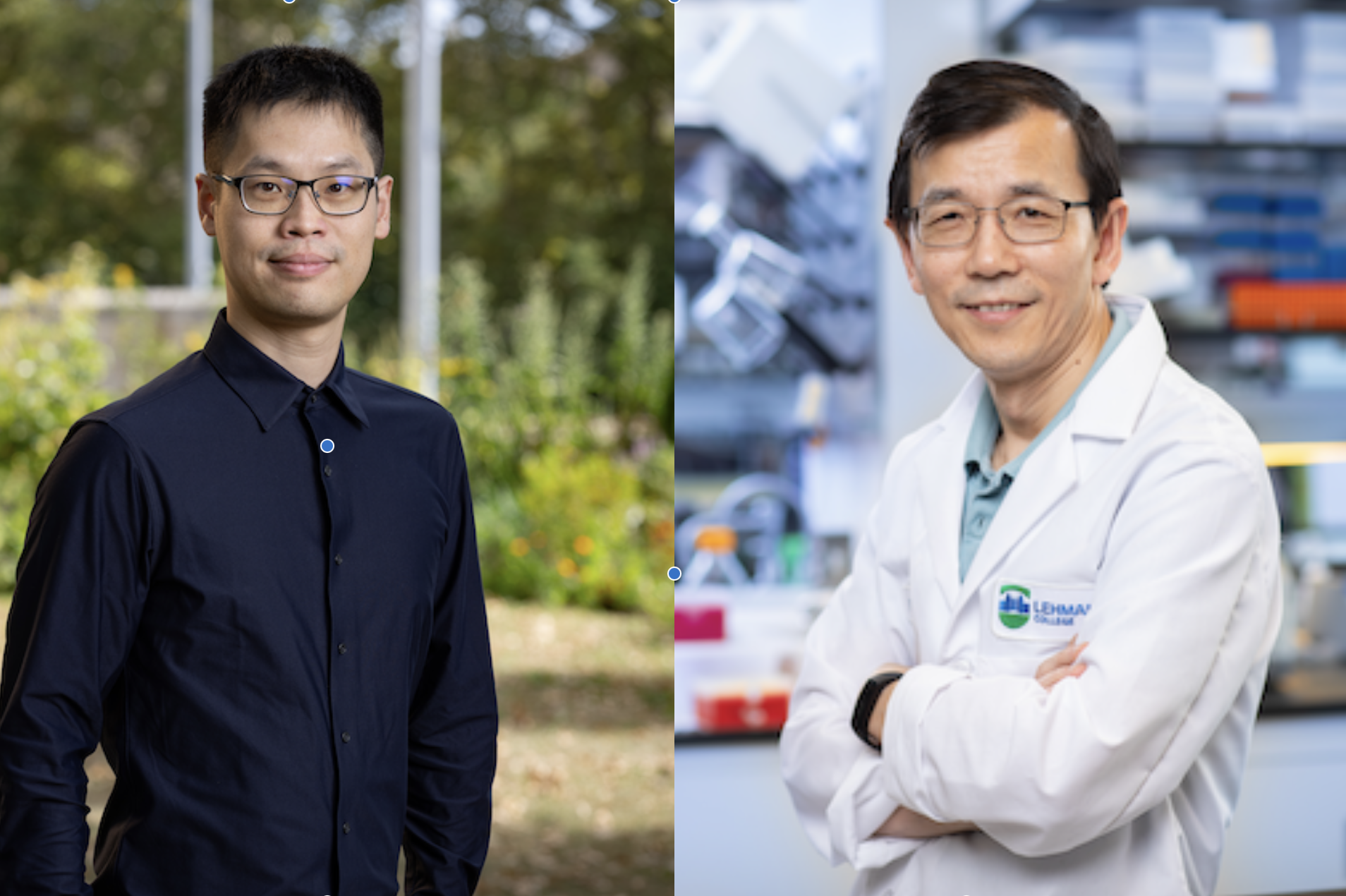
Left to right, Chun-I Wang and Hai-Ping Cheng
November 10, 2026
Two Lehman College faculty members have each received four-year grants from the National Institutes of Health (NIH) through its Support for Research Excellence (SuRE) program to advance research with promising medical applications—and create career development opportunities for undergraduate and graduate students. Each grant will support four to five student researchers.
Chun-I Wang, assistant professor of chemistry, is exploring ways to design materials that could one day help doctors see tumors and other tissues more clearly during surgery. His SuRE award, totaling more than $600,000 and marking his first federal grant as a principal investigator, will support the development of brighter fluorescent nanoparticles that could improve medical imaging. The research combines computer simulations and artificial intelligence, giving students hands-on experience at the intersection of chemistry, AI, and medicine.
“Machine learning helps us find which molecular arrangements matter and predict how a material will perform before anyone makes it in the lab,” said Wang. “Our goal is to turn that understanding into clear design rules, so experimental chemists can create better materials faster, whether for medical imaging, flexible electronics, or other technologies.”
An award of nearly $570,000 from the National Institute of Allergy and Infectious Diseases through the SuRE program will enable Professor of Biological Sciences Hai-Ping Cheng to continue his research into novel bacterial compounds that appear to have antibiotic properties, including against bacteria resistant to conventional treatments. The findings could point toward new ways to fight dangerous infections. Students working in Cheng’s lab will play a key role in uncovering the science behind this phenomenon and exploring its potential.
“We’re very excited,” said Cheng. “People ask me about the difference between having funding and not having funding. With four full years of funding, I can really focus on analyzing the problem.”