


News
Search All News
Wednesday, October 7, 2026
Office Hours
Monday - Friday 9am - 5pmClosed Sat. and Sun.
Finding His Voice: Dwight Liburd ’94 Shares His Aphasia Recovery
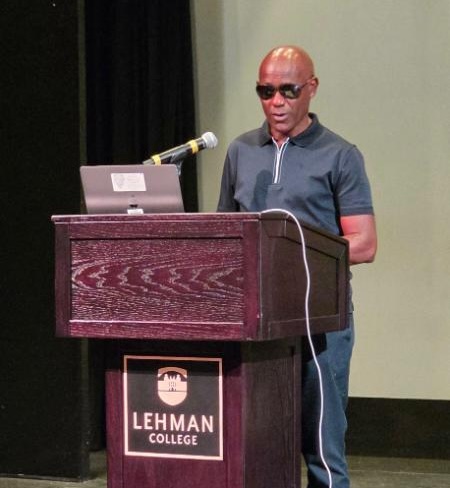
Dwight Liburd speaks at the book launch
October 7, 2026
Lehman alumnus Dwight Liburd celebrated his new book with a release party at Lehman College, where he spent more than a decade working with speech therapy students. A Voice of the Voiceless: My Recovery from Aphasia chronicles his journey to regain the communication skills he lost after a stroke in 2010.
When Liburd awoke from a coma in the hospital, his right side was paralyzed; he did not recognize family and friends; and he had aphasia. The condition affects language processing and presents in many forms, but Liburd was suffering from global aphasia. It affected his ability to speak, read, write, and understand speech and text.
Completely regaining communication skills is unusual for people with global aphasia, but Liburd continued outpatient therapy for fifteen years, determined to recover his speech, literacy, and mobility.
“I told myself, when I get back my senses, I will walk, and I will talk. I will read, and I will write,” he said. “I found the way with patience. A lot of people with aphasia will want to talk right away. But I told myself, ‘I will give it some time.’”
In 2013, Liburd learned about the College’s Speech and Hearing Clinic. He began therapy on campus remained a client for more than 10 years, working with students training in speech pathology and their faculty supervisors, including Professor Mira Goral.
Each semester, he worked with new student clinicians in the program. While they were helping him relearn to speak, write, and read, he was teaching them what he had learned from living with aphasia. “I had the stroke, so I would tell the therapist it’s a 50-50 arrangement,” he said.
Over the years, Goral and faculty members at other institutions invited Liburd to speak with classes studying aphasia. In 2025 he decided it was time to share his experience with a broader audience, and approached Goral about turning his story into a book.
It was a collaborative effort: Liburd wrote the material, while Goral helped him organize it. Her husband, a professional editor, also assisted with the project.
Liburd wants readers to understand that his experiences living with aphasia are shared by many people who have lost language.
“I tell my story because I want the world to know it relates to all people who have aphasia,” he said. “If they can’t talk, then I can tell my story—but it’s not my story. It’s all of ours.”
He hopes the book will encourage others with aphasia to find their voice and believe they can continue to improve.